These days search engines are praised for their educated guesswork. Each pile of results is presented with an implication: "here's what we think you want."
But most serious researchers (i.e. Yours Truly and all Linux Journal readers) often don't want an engine to guess. These users want to search for specific strings — or, as some search engines put it, phrases. These include names, text passages, lines of code, diseases and all other series of words.
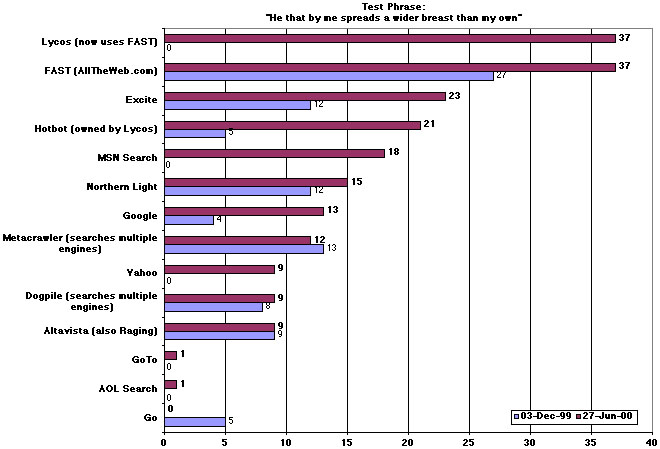
On December 3, 1999 and June 27, 2000, I tested fifteen of the most familiar search engines by searching for a relatively unique phrase: "He that by me spreads a wider breast than my own" — which is part of a familiar line from Walt Whitman's Song of Myself. The phrase occurs far from the beginning of the work, and in many documents on the Web, including one on my own site <www.searls.com>.
It's a tough test. Only those engines that deeply search an enormous range of sites will yield results. The word "breast" is also a common and controversial word, which might invite spurious results.
Testing for strings also isn't easy on the tester, since search engines have different ways of recognizing phrases. Most require quotes. Others (Hotbot, FAST) have pop-out menu commands. One (Yahoo) requires clicking a radio button in "advanced" search mode. Others (mostly at the bottom in the surveys) don't search phrases at all.
I run this test quite often for my own purposes, and rarely record the results. But last December I did record them; and I repeated the test again on June 27 — nearly seven months later. This time I added two more tests: one for an obscure blood disorder and the other for a Linux system call. Here are the results:
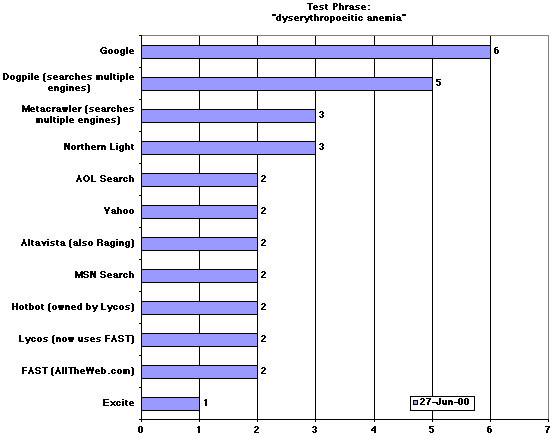
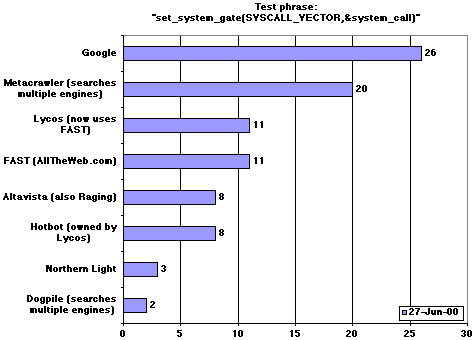
As you see, FAST won the first search, by a wide margin, just as it did in December. But Google is the clear winner the second and third searches — and didn't do too bad on the first, either.
Near as I could tell, none of the engines fell for the "breast" bait — at least not in phrase search mode. On that one they all get a passing grade.
Some of the results, however, were amazing. Go.com found "29,024,074 matches" in the first search, but nothing I wanted. The first ten results all related to breastfeeding or breast cancer. No porn, of course. But I get a banner ad featuring a happy-looking woman in a cleavage bra. "BREAST AUGMENTATION?" it asked. "Looking for breast augmentation from a doctor in your area? CLICK HERE." Nice guess, guys.
As we see, search is consolidating as a business category. By the time you read this, Yahoo will be using Google (in a deal struck one day before this survey). Other partnerships and cross-investments are sure to follow (Lycos recently bought a 15% stake in FAST, for example). My guess is that there will be fewer search engines by the time you read this.
I just hope there aren't fewer good ones.
— Doc Searls